
Building Rapport with Students When You Don’t Speak Korean
June 15, 2026
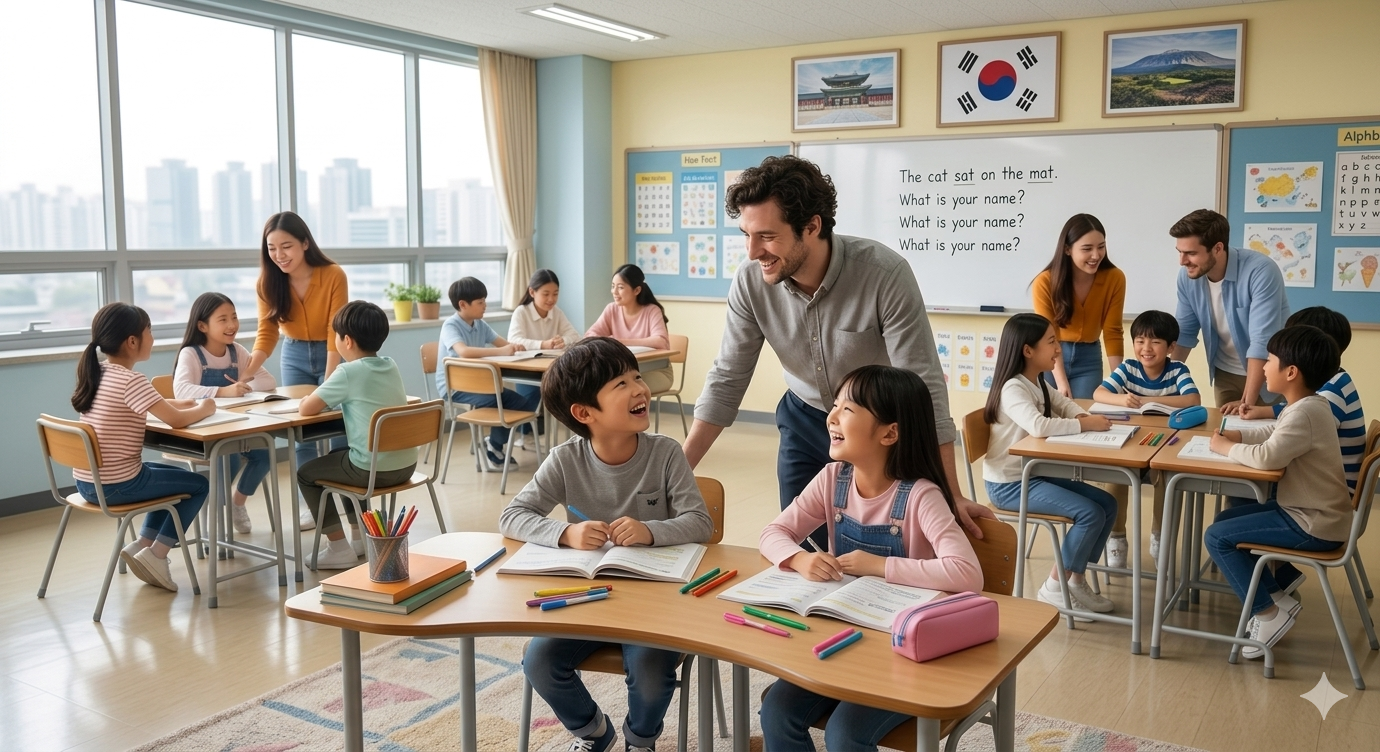
“”One of my students once asked through a translation app why I came to Korea. I told her honestly: because I wanted adventure and to learn from people different from me. She wrote back, “You are learning Korean heart, not just Korean language.” She was right. And that’s exactly the kind of rapport that makes teaching unforgettable..
I’ll never forget my first day teaching in Seoul. I walked into a classroom of 35 middle schoolers, armed with my TEFL certificate and a head full of lesson plans, only to realize that my carefully crafted icebreaker game made absolutely no sense to anyone in the room. The language barrier wasn’t just real—it was a wall I hadn’t quite prepared to climb.
But here’s what I learned over my three years teaching in Korea: you don’t need to speak Korean fluently to build genuine connections with your students. In fact, some of my strongest relationships formed precisely because we had to get creative about communication.
Start with Names (and Get Them Right)
This seems obvious, but it matters more than you think. I made flashcards for every single student and practiced their names obsessively during my first week. When Min-jun realized I’d memorized not just his name but also his desk location and the fact that he loved drawing Spider-Man, his whole attitude shifted. He went from avoiding eye contact to showing me his sketchbook every single class.
The trick? Don’t just learn their English names if they have them. Ask about their Korean names too. Even if you butcher the pronunciation at first (I definitely did), students appreciate the effort. They’ll giggle, correct you gently, and suddenly you’re having a moment of connection that transcends vocabulary.
Body Language Speaks Volumes
I became a master of exaggerated facial expressions. Excitement, confusion, pride, curiosity—I learned to project these emotions in ways that needed no translation. When a student shared something in broken English, my genuine enthusiasm said more than any “Good job!” ever could.
High-fives became my currency. Thumbs up, surprised faces, celebratory dances when someone nailed a difficult pronunciation—these weren’t just classroom management tools. They were the beginning of real relationships. So-yeon, who barely spoke during my first month, eventually started volunteering answers because she knew she’d get our secret handshake when she tried.
Meet Them Where They Live
K-pop, webtoons, mobile games, Korean baseball—these became my homework. I didn’t need to speak Korean to ask about BTS or show interest in the latest episode of whatever drama had the school buzzing. When I mentioned Stray Kids one day, half the class nearly fell out of their chairs. Suddenly, I wasn’t just the foreign English teacher. I was someone who cared about their world.
I kept a running list of student interests in a notebook. Jun-ho likes soccer. Ye-jin watches every Marvel movie. Min-seo is obsessed with her golden retriever. These little details became conversation starters that required minimal Korean on my part but maximum listening—something that works in any language.
Use Technology as Your Bridge
Translation apps aren’t cheating—they’re tools. When a student wanted to tell me something important but couldn’t find the words, we’d huddle over my phone together, typing and laughing at awkward translations. Those moments of collaborative problem-solving built trust in ways that perfect communication never could.
I also started a class Instagram account where students could share photos and I’d comment with simple English phrases. They’d respond with their attempts at English, sometimes with Korean mixed in, and we’d figure it out together. The barrier wasn’t gone, but we’d turned it into something we navigated as a team.
Be Hilariously Bad at Korean (On Purpose)
I learned basic phrases—”안녕하세요” (hello), “감사합니다” (thank you), “화장실” (bathroom, extremely important)—but I made a show of being terrible at them. Students loved correcting my pronunciation. It leveled the playing field. They were learning English from me, and I was learning Korean from them. The mutual vulnerability created space for authentic connection.
Every week, I’d ask students to teach me a new word. We’d spend five minutes of class with me trying to pronounce it correctly while they offered patient (and amused) feedback. Those were often the moments when even my shyest students would pipe up to help.
Food is a Universal Love Language
I learned to love 떡볶이 (tteokbokki), even though the spice level nearly killed me at first. When students invited me to try their favorite snacks from the convenience store, I said yes—even to the dried squid. When I brought American snacks to share, we’d compare and contrast, making faces at unfamiliar flavors together.
The day I showed up with homemade cookies, word spread through the entire grade level by lunchtime. Food creates memories that outlast any grammar lesson. Years later, former students still message me about “that time Teacher brought the strange peanut butter candies.”
Show Up to Their World
School festivals, talent shows, sports days—I attended everything I could. You don’t need to speak Korean to cheer loudly from the bleachers or marvel at a student’s traditional dance performance. Your presence says, “I see you. You matter.” That message comes through clearly in any language.
When I attended Ji-woo’s piano recital at her mom’s invitation, she cried. Not because I said anything profound (I couldn’t), but because I showed up. That’s the thing about building rapport—sometimes it’s less about what you say and more about where you choose to be.
Create Rituals That Don’t Need Words
Every Friday became “Share Something Cool” day. Students could bring anything—a drawing, a photo, a song, an object—and present it to the class in whatever language capacity they had. I’d respond with enthusiasm and simple English questions. Over time, these presentations became less about language practice and more about students trusting me with pieces of themselves.
We also started a “Compliment Circle” where students wrote nice things about each other on sticky notes. I’d participate too, using Google Translate when needed to make sure my messages were clear. The board filled up with a rainbow of notes in English, Korean, and sometimes both, creating a visual reminder that connection doesn’t require linguistic perfection.
Be Patient with Silence
Not every student will warm up quickly, and that’s okay. Jae-hyun didn’t speak to me directly for four months. He’d complete assignments perfectly but avoided all personal interaction. Instead of pushing, I just stayed consistent—greeting him every day, commenting on his excellent work, being present without demanding reciprocation.
One day, he brought me a drawing of my dog (whose picture I’d shared once). No explanation, just a gift and a small smile. We didn’t suddenly become chatty with each other, but something shifted. He knew I was a safe person, and I learned that rapport doesn’t always look like conversation.
Embrace the Awkward
There will be misunderstandings. You’ll accidentally say something confusing. Students will try to explain something and you’ll both end up laughing because nobody knows what anyone means. These moments aren’t failures—they’re the foundation of genuine relationships.
Once, I spent ten minutes acting out “photosynthesis” using construction paper leaves and dramatic gestures because the translation wasn’t landing. The class was in tears laughing at my performance. Did they understand photosynthesis by the end? Mostly. Did we bond over my ridiculous plant impression? Absolutely.
Remember: You’re a Person, Not Just a Teacher
I shared age-appropriate pieces of my life—photos of my family, stories about my hometown, my failures at cooking Korean food. When you show students your humanity, they respond with theirs. The language barrier matters less when you’re both just people trying to connect.
One of my students once asked through a translation app why I came to Korea. I told her honestly: because I wanted adventure and to learn from people different from me. She wrote back, “You are learning Korean heart, not just Korean language.” She was right. And that’s exactly the kind of rapport that makes teaching unforgettable.
Related Articles

Teacher Needed in Suwon
We are searching for an enthusiastic teacher who loves literature and creative writing. We are a small English academy that teaches advanced-level elementary students. We always aim to create a stress-free, friendly environment for both students and teachers. We work…
![[Direct Hiring] Academic English Instructor (Gangnam, Seoul)](https://koreateaching.com/wp-content/uploads/2026/10/seoul-teaching-jobs.png)
[Direct Hiring] Academic English Instructor (Gangnam, Seoul)
IEN Institute provides university pathway programs to young adults intending to pursue their degree studies in the UK, Australia, New Zealand, Canada, US, and other countries. We are a Continuing Education institute with a global outlook, seeking talented…
★ GWANGMYEONG, Near Seoul | KRW 3.3M+ + Paid Annual Leave | Elementary English Teacher | Your Own Classroom ★
Contract – Classes : Speaking, Writing and Presentation – Working days: Mon-Fri (5days a week) – Working hours : 1:00 p.m. to 9:00p.m. (8 hours/day) – Teaching type : Grade 1-6th (Elementary school), Kindergarten – Location: Gwangmyeong…
English Teachers wanted in BUNDANG!
Established in 2011, AKADEMIA Bundang is a reputable English Academy located in Jeongja-Dong. We are currently looking for enthusiastic and responsible individuals to join our teaching and R&D staff. Applicants should have either F series or E series visas….